|
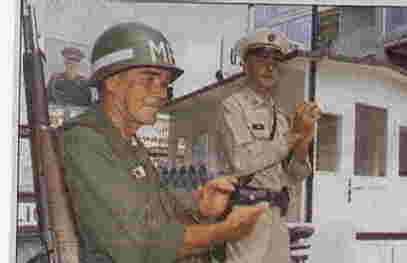
BERLIN - The guardhouse went up again at Berlin's infamous Checkpoint
Charlie and parts of the 'Berlin Wall also will be rebuilt at the border
crossing where Cold War powers formerly faced off just yards apart.
But Berlin isn't about to become a divided city again.
This time, the guards wearing U.S. and British military uniforms were
Germans in costume, participating in the unveiling Sunday of a guardhouse
rebuilt to serve as a reminder to future generations of the barrier that
divided a country, Europe and the world.
"Our duty is to maintain and salvage what was once here," said
Rainer Hildebrandt, head of the
Museum at Checkpoint Charlie and a leading force behind preserving the
memory of the scar that ran through Berlin.
It
was exactly 39 years ago on Sunday that construction began on the Wall. East
German leaders called it an "Anti-Fascist Protection Barrier,"
although the real goal of the Wall was to stop thousands of their citizens
from leaving.
Before the Wall went up, people could travel freely, across Berlin and many
who lived in one part of the city worked in the other. That all changed
after Aug. 13, 1961, when East German soldiers began stringing lengths of
barbed wire and building barriers across the city.
Checkpoint Charlie - the third checkpoint in the city after Alpha and Bravo
- got its first guardhouse Sept. 22, 1961. In the months that followed, both
the United States and Soviet Union stationed tanks there on what became the
front line in the Cold War.
The checkpoint was known for its trademark "You are leaving the
American sector" sign.
Those tanks wouldn't move until after Nov. 9, 1989 - when East Germans
streamed across the border after the government lifted travel restrictions
that had been in place for more than 28 years.
After it fell, Berliners were more than eager to tear down all signs of the
Wall.
Thousands of tourists chipped pieces away, and much of the Wall was
ground up and used to make roads. The previous guardhouse at Checkpoint
Charlie was removed June 22, 1990, as diplomats from the Allied powers
looked on. Now, more than 1 0 years after the Wall fell, there have been
efforts to try and preserve the memory of the most visible manifestation of
the Iron Curtain.
In addition to the new white, wooden guardhouse in an island in the road at
Checkpoint Charlie, the museum hopes to restore elements of the entire
barrier system - which included the no man's land between the Wall’s two
sides.
Restoration work also has begun across town on one of the largest remaining
strips of the Wall, the so-called East Side Gallery, where artists after
1989 decorated what was once the untouchable eastern side of the barrier
with pictorial odes to peace.
Major Nigel Dunkley, the British military attaché who spoke at the
guardhouse dedication, remembered the hard stares he received from East
German border officers and the cameras that watched his every move when
passing through the border.
“The
younger generation does not have any concept of the oppressive atmosphere,"
he said.
"We tend to forget how terrible, it was, and it's not a bad idea
to remind people."
|